Why we exist
Progress is limited by access to materials.
There are only two ways to produce: extract finite resources from the earth, or use what already exists. We've spent two centuries perfecting the first. We're building the second — starting with textiles.
Future 01 — runs out
Take, make, dispose
Virgin polyester from oil, virgin cotton from strained land and water. A linear model that mines finite resources and landfills the result.
Future 02 — we're building it
Recover, regenerate, repeat
A second stream of raw materials, recovered chemically from the waste the industry already produces — making the circular option the rational choice.
Technology
CO2-driven molecular regeneration
Our glycolysis-based process breaks polyester–cotton blends down at the molecular level, recovering BHET — the building block of PET — and clean cellulose fibres, ready to become virgin-quality material again.
Loading
Post-consumer polycotton waste goes straight into the reactor — no separation into pure polyester or pure cotton streams required.
Depolymerization
Polyester is broken down to its molecular building block, BHET, while the cotton fibres are recovered intact.
CO2-driven glycolysisRegeneration
Recovered building blocks are re-polymerized into virgin-quality raw materials, ready to re-enter production.
BHET · PET monomer Cellulose fibresThe product
GLYON ONE - Elizabeth.
A recycling plant that ships in a container.
Deployed where the waste is — at sorters, laundries, brands and municipalities. Designed to scale, designed to recover value locally, designed to make extraction the outdated option.
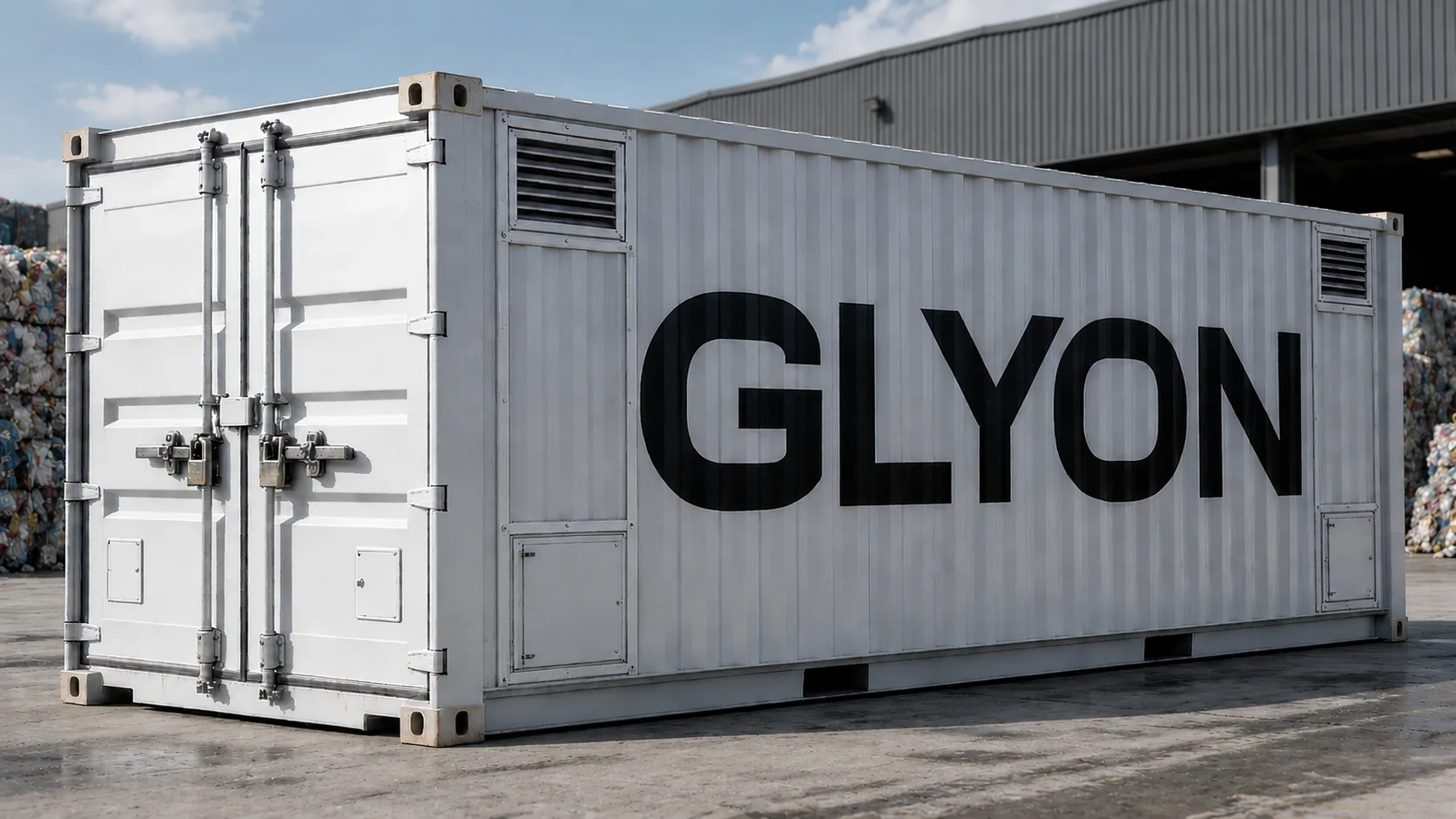 Concept render · outdoors, at the waste source
Configure your unit
No payment today. Reserve a production slot - our team confirms your specification, siting and delivery window within 5 working days.
Request received.
Your production slot request is in. We'll come back with specification and delivery details within 5 working days.
Backed by
Leading innovation programs





Team